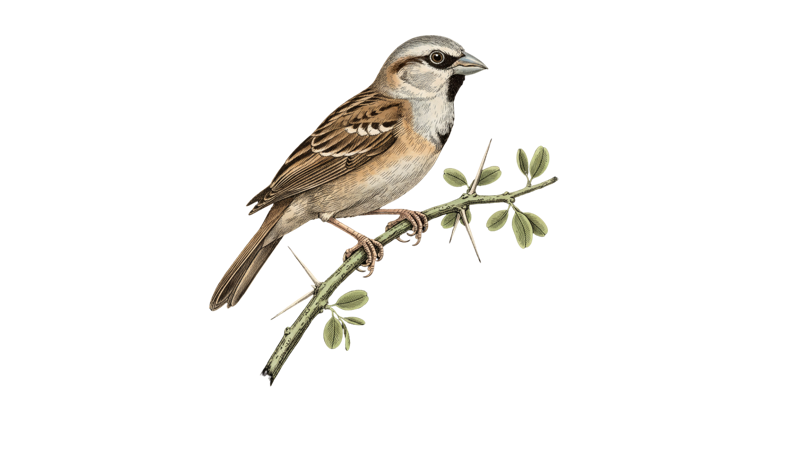
Seventeen hours of autonomous acoustic recording. Twenty-nine bird species. One thousand two hundred and ten detections. A refutation of the narrative that has shaped conservation policy for a century.
By Zakher Bouragaoui · National Geographic Explorer
Scroll to listen
A thing is right when it tends to preserve the integrity, stability, and beauty of the biotic community. It is wrong when it tends otherwise.
— Aldo Leopold, A Sand County Almanac
I — The Official Version
Let me begin with the version of this story you already know.
The Sahara Desert is dying. Or, more precisely, the Sahara Desert is already dead, and the land around it is dying — crumbling under the combined pressure of overgrazing, climate change, and the creeping advance of sand that is swallowing farms and villages and entire ways of life along its southern edge. The solution is obvious, urgent, and now backed by the African Union, the United Nations, the World Bank, and the passionate endorsement of celebrities, heads of state, and TED speakers across four continents. We will build a Great Green Wall — a literal belt of trees, eight thousand kilometres long, stretching from Dakar to Djibouti — and we will plant life back into the dead places.
This is the official version. It is coherent, it is well-funded, and it has been told so many times, through so many channels, that it has acquired the texture of fact. And like many things that acquire the texture of fact, it begins to crumble the moment you actually go there. Not to study it from above. Not to model it. Not to write policy about it. To go there, in a car, with a microphone listening to the thing you have been told is silent.
I am a conservation biologist. I grew up in Tunisia. I have applied acoustic ecology methods to forests in the Sierra Nevada and ecosystems from Wisconsin to North Africa. In April of 2026, I drove south into the Sahara with an autonomous recording unit, a deep-learning algorithm trained on six thousand bird species, and a question so simple: what does this place actually sound like?
We have been telling a story about a landscape we have never listened to.
34° N · The Mediterranean Transition
II — The Ones Who Came Looking for Other Things
Before I went south, others went before me.
In 1885, a French military veterinarian named Philippe Thomas was walking the scorched hinterlands near Métlaoui when he discovered phosphate deposits of extraordinary scale. A mining company was formed. A 250-kilometre railway was built. By 1909, the company was clearing eight million francs in annual profit. Thomas received a one-time gift of fifteen thousand francs. He died in 1910, the year the real money started flowing. He also discovered and named a fossil crocodilian in the phosphate beds — Dyrosaurus phosphaticus — because even when you are being robbed of your discovery, the landscape keeps offering you new ones.
The eccentric ornithologist Joseph Whitaker — son of the Ingham-Whitaker Marsala wine dynasty — spent ten years making collecting expeditions across Tunisia, sleeping in camps at the edge of the Saharan south, and published The Birds of Tunisia in London in 1905: two volumes, fifteen hand-coloured plates, two hundred and fifty copies, and three hundred and sixty-five species recorded in the dead desert.
And then there was Théodore Monod, the French naturalist who explored the Sahara for seventy-five years, published seven hundred scientific works, once walked six hundred miles across it to prove he needed no meat to survive, and loved this landscape not as a void to be filled but as a living text that most people lacked the patience to read.
The desert is beginning to be described by the people who grew up inside it.
PLATE I
Acacia raddiana at the Mediterranean-Saharan transition. The last trees give way to sand — but transitions are not endings. They are thresholds.
III — The Road South
I left Tunis on a morning in April and drove south.
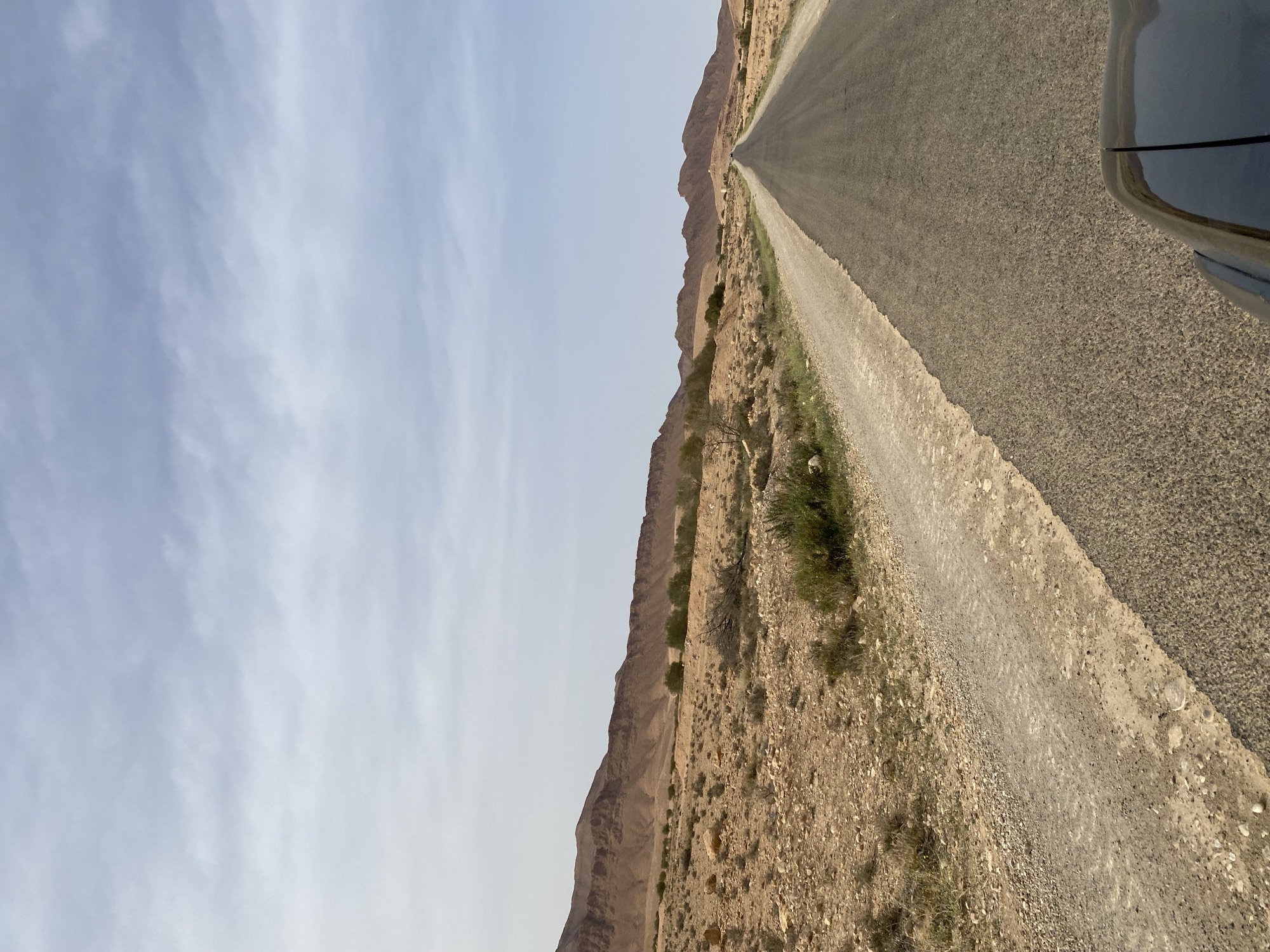
Not metaphorically. Literally south, past Hammamet, past Sfax, down through the spine of Tunisia toward a landscape that half the world had watched on television without understanding and the other half had been designing solutions for without visiting. The further south you drive, the more the land clarifies itself. The Mediterranean green of the northern coast gives way to the pale steppe. The olive groves thin. The horizon flattens and lengthens. The air changes quality — drier, cleaner, more honest. The land stops pretending to be something it is not.
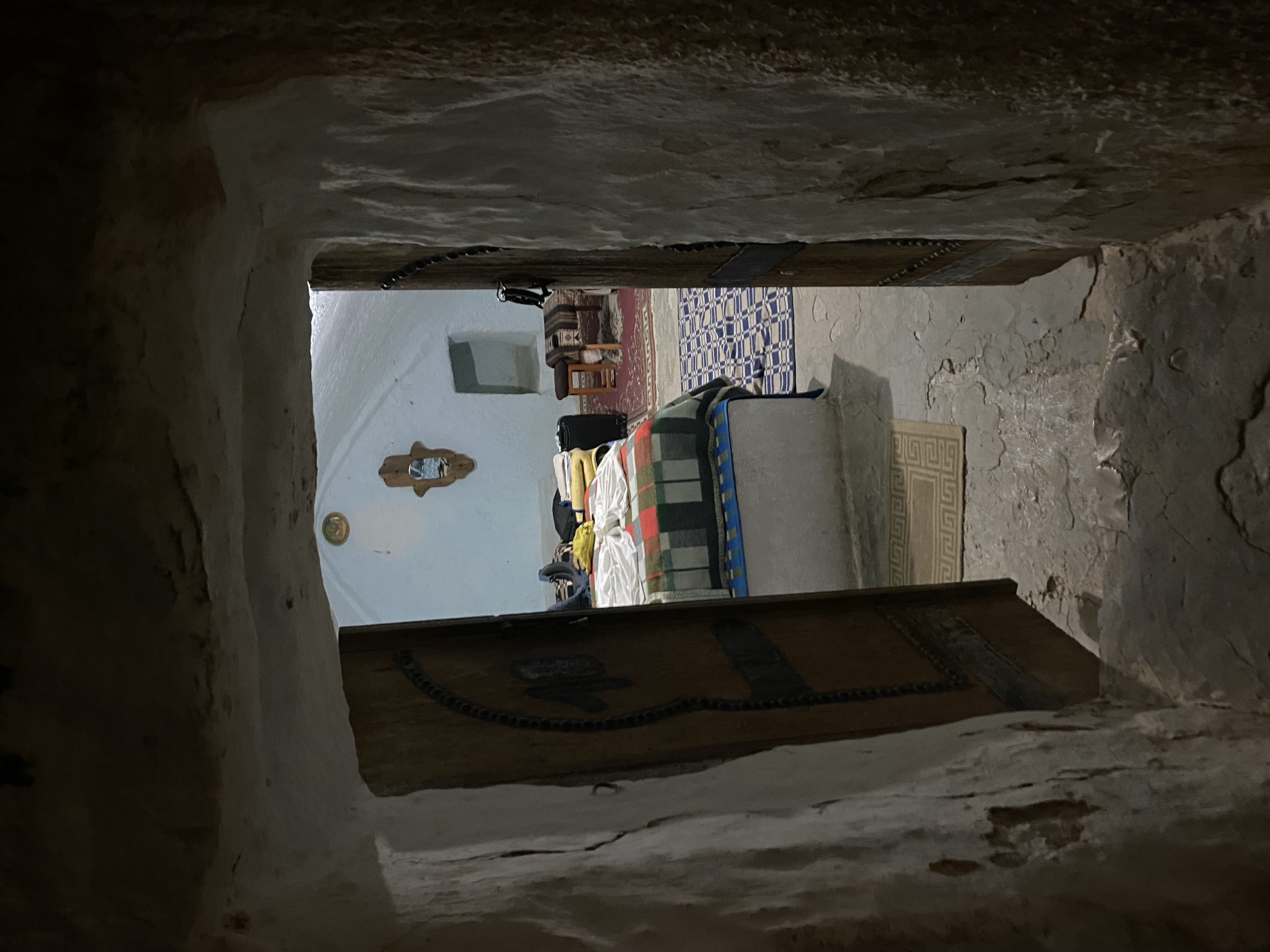
Matmata arrives first, and it stops you in your tracks whether you expect it to or not. The town is built downward — into the earth, not upward above it. The troglodyte houses are dug as circular pits five to ten metres deep into soft sandstone, with rooms carved laterally into the walls. When the outside temperature climbs above forty-five degrees Celsius, the rooms hold at twenty-two. No electricity for cooling. No technology. Just the accumulated intelligence of a people who looked at an apparently inhospitable environment and thought: not a problem to be solved — a logic to be learned.
They called the place Athwab — in the Amazigh language, the language still spoken in the nearby village of Techine: the place of happiness and well-being. George Lucas called it Tatooine, changing a single letter from the nearby town of Tataouine, and filmed Luke Skywalker's home planet here. Tunisia holds more official Star Wars filming locations than any other country on Earth. The galaxy's most famous fictional wasteland is a fully inhabited, architecturally sophisticated Berber community whose geology holds Cretaceous fossils of Spinosaurus and is listed officially this April 2026 as UNESCO Global Geopark.
Empires rise and fall. Partridges persist.
PLATE II
Old Matmata — troglodyte architecture carved into sandstone. Thermal mass regulation: 22°C interior when surface temperatures exceed 45°C. Vernacular sustainability that predates the term by centuries.
IV — Ksar Ghilane: Where a Spring Changes Everything
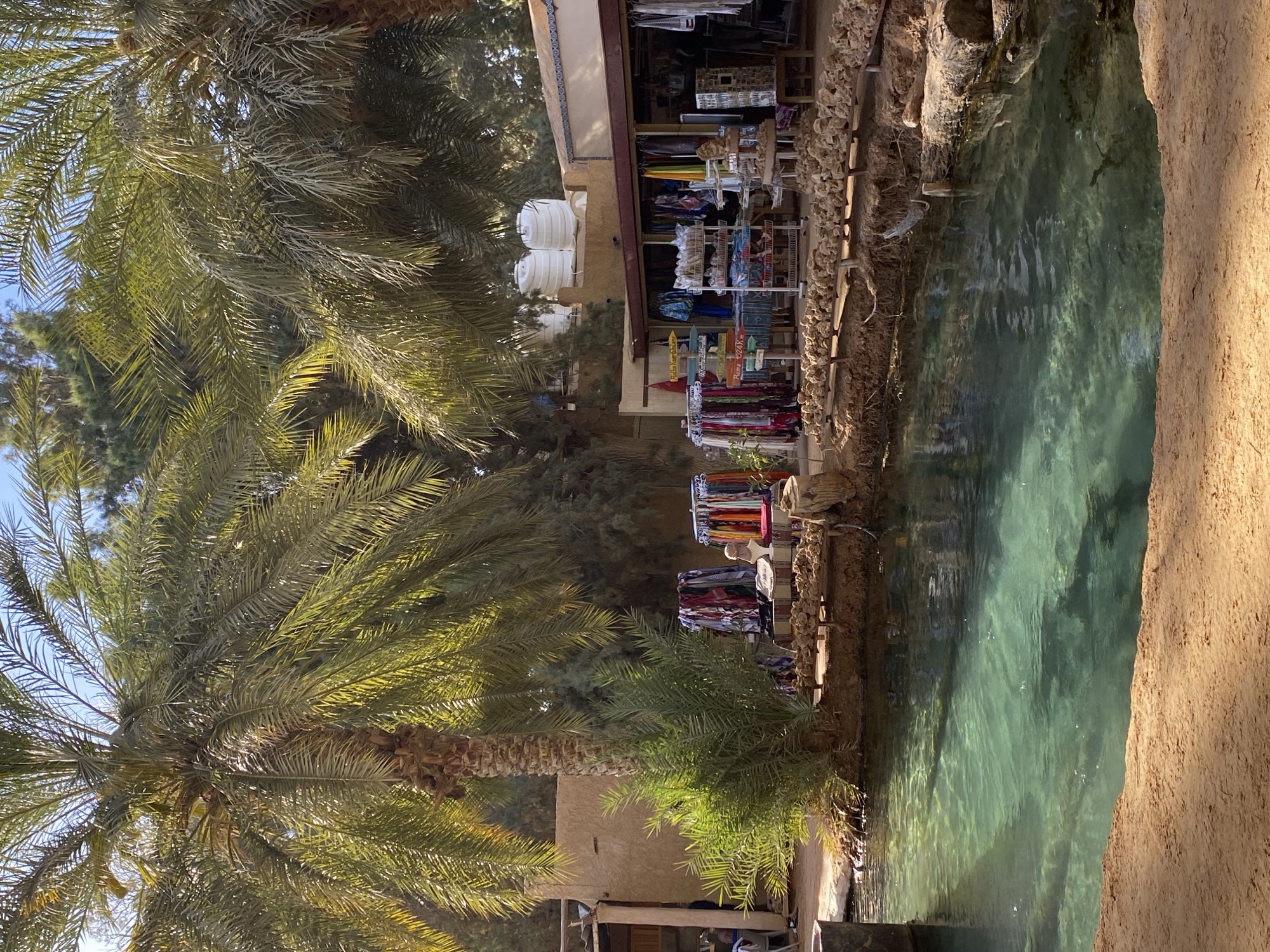
The oasis exists because of a hot spring.
That is the whole story, reduced to its elements. Somewhere beneath the sand, ancient groundwater that has been moving slowly through limestone aquifers for thousands of years rises to the surface — warm, mineral-rich, continuous. It has been rising since before the Roman Empire. It creates a pool. The pool feeds a stand of date palms. The palms create shade. The shade drops the surface temperature by fifteen degrees. The microclimate this creates — moister, cooler, sheltered — produces conditions that should not exist within two hundred kilometres in any direction.
And life, being life, moves in.
Approximately fifty families live here now, their livelihoods built on dates and herding. Before them, the Emperor Commodus stationed a garrison here in the late second century CE: the Castellum Tisavar, a border post on the western edge of the Limes Tripolitanus, the Roman Empire's southernmost frontier. Three structures remain on a small hill above the oasis, half-consumed by sand drift.
In 2010, a Martian meteorite — catalogued as Ksar Ghilaine 002 — fell near the oasis. A piece of Mars, recovered in the dead desert. The spring has been attracting visitors for two thousand years.
PLATE III
Qsar Ghilane oasis — where ancient groundwater rises continuously from limestone aquifers.
V — The Deployment
At 15:27 local time on April 10th, 2026, I pressed record.
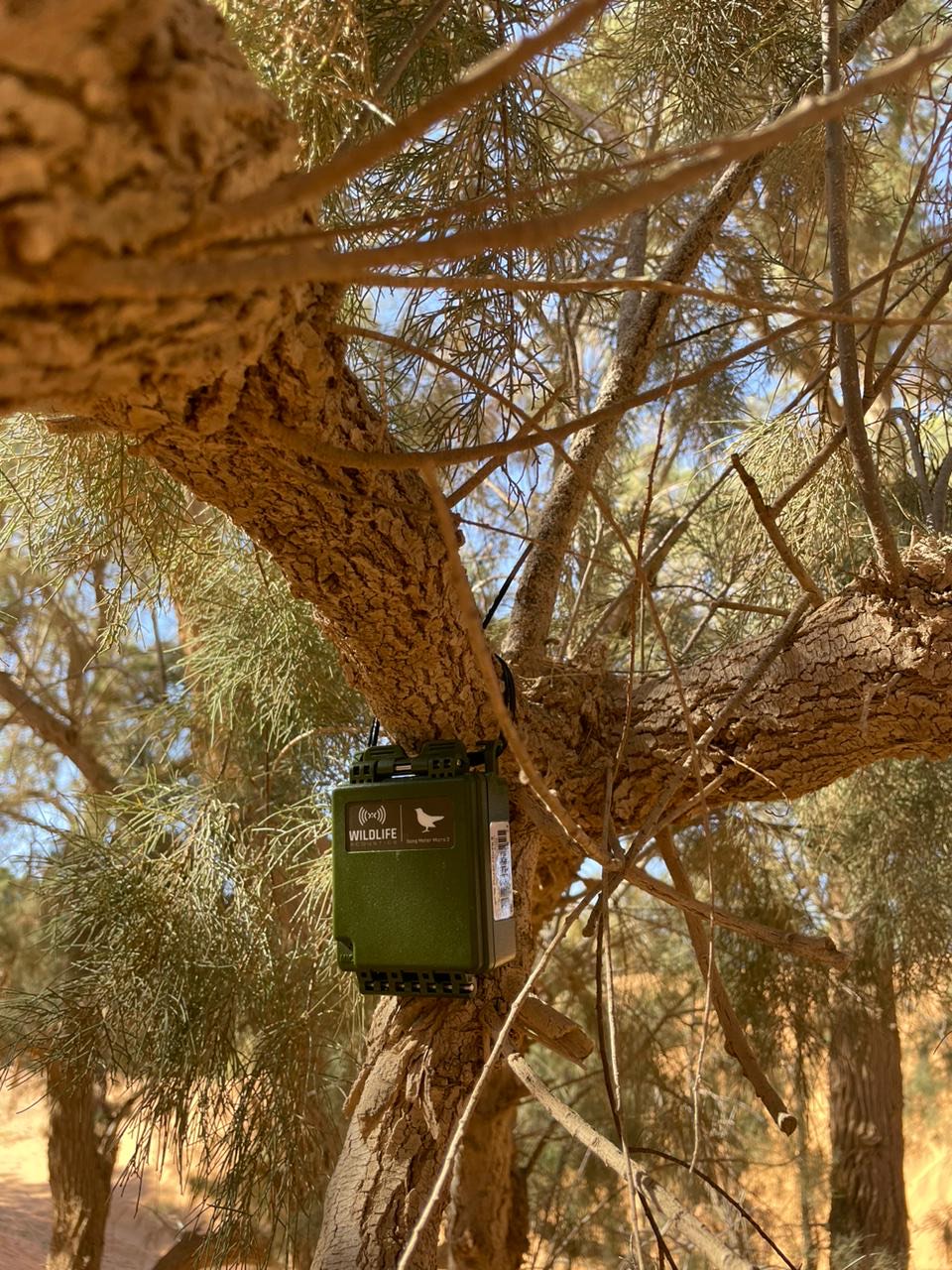
I arrived in the late afternoon and deployed the recording unit — a Wildlife Acoustics Micro 2, loaded with a deep-learning algorithm that Cornell University had trained on the voices of more than six thousand bird species.
29Species Detected
1,210Vocalizations Conf. ≥ 0.50
17hContinuous Recording
What I was about to do had never been done here, or anywhere in North Africa, or anywhere on the African continent south of Egypt: deploy a systematic acoustic monitoring station in the Saharan ecosystem. Not because it was technically difficult. Because no one had thought to.
We had been too busy arguing about what this landscape lacked to listen to what it contained.
The desert was not waiting for us to save it. It was waiting for us to notice it.
PLATE IV
Wildlife Acoustic Recorder (Micro 2) on a tree. Weatherproof, battery-powered, listening continuously where human observers cannot stay.
VI — What the Numbers Say
Numbers, in ecology, are argumentative.
The question is not just how many species, but what that number means in a landscape presumed to be degraded or empty.
Figure 01
Top twenty species by detection frequency
N = 1,210
Eurasian Collared Dove (511 detections), Eastern Olivaceous Warbler (232), and Eurasian Scops-Owl (159) together accounted for 74.6% of all detections. The long right-skew is the statistical signature of a real ecological community.
Figure 02
Acoustic activity by hour
DawnMorningAfternoonDuskNight
Dawn chorus peaks 05:00–07:00. Dusk (0.2%) marks the acoustic silence between diurnal and nocturnal guilds.
Figure 03
Geographic plausibility
Confirmed · 15 speciesPossible · 14 species
Confirmed residents generated 95.1% of all detections (1,151 / 1,210) — the majority of the acoustic evidence comes from established regional fauna.
Figure 04
Species accumulation over 17 hours
Curve did not reach asymptote
The curve had not fully asymptoted — meaning there was more here than seventeen hours could find. The dead desert had more to say than I had given it time to hear.
VII — The Night the Desert Told the Truth
The recording unit did not go to sleep.
It processed 523 consecutive one-minute files through seventeen unbroken hours, and the picture it assembled of the nocturnal desert was unlike anything the existing literature had described, because the existing literature had never tried to describe it.
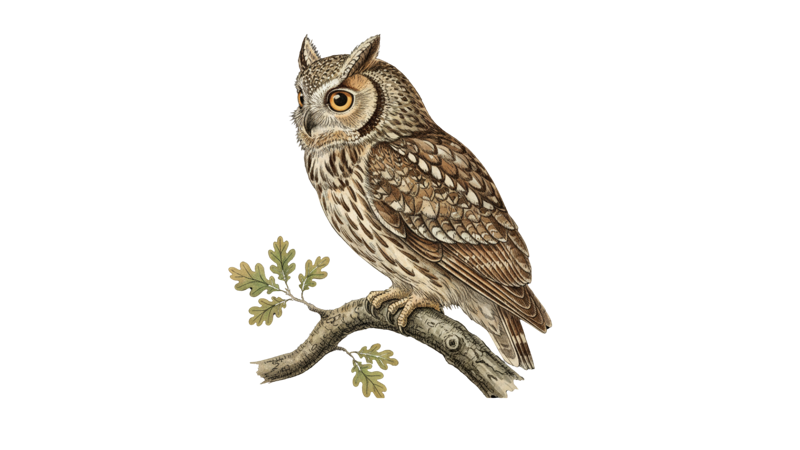
The first voice of the night belonged to the Eurasian Scops Owl — that single, monotonously repeated pyuu, arriving from somewhere in the palms shortly after darkness fell and continuing for most of the night. One hundred and fifty-nine detections. Almost entirely nocturnal.
Consider what this bird is. It weighs between sixty and one hundred and thirty-five grams — less than a tennis ball. It is the only European owl that makes a full trans-Saharan migration, crossing two thousand kilometres of desert twice a year. A 2024 study documented something extraordinary: Scops Owls bring live worm snakes into their nests — not to eat, but as pest control. The snakes feed on the ants, fly larvae, and ectoparasites that threaten the chicks. In the dead desert, at midnight, a 130-gram owl is running an integrated pest management operation.
And then, between 22:00 and 03:00, the recording caught the unmistakable call of the Common Crane — a flock, almost certainly, crossing overhead in total darkness. These birds have been crossing this oasis every spring, for longer than the Roman garrison existed, longer than the caravan routes, longer than written language.
Seven species detected exclusively at night — invisible to every survey ever conducted here.
05:10 · Forty-four Minutes Before Sunrise
VIII — Dawn, and What Arrives With It
At 05:10 on April 11th, the dawn chorus began.
In a temperate forest, the dawn chorus is a luxury. In the desert, the dawn chorus is a race against thermodynamics. The window between cool enough to sing and too hot to function is narrow — sometimes as little as ninety minutes — and every creature with something to communicate compresses its entire vocal agenda into that window. What you hear is not leisure. It is urgency.
The Common Redstart opened proceedings. Thirty-four detections. This bird weighs between eleven and twenty-three grams. It has just crossed the Sahara. Studies of Redstarts grounded at desert oases found that sixty percent of individuals lacked sufficient fat reserves to complete the remaining crossing. For every one of those birds, Ksar Ghilane is not picturesque. It is the difference between this generation passing on its genes and the lineage ending here, in the sand, in April.
The European Turtle Dove arrived with six detections — that soft, rolling purr that the Song of Solomon described three thousand years ago. Since 1980, its European population has declined by 78 percent. Between two and four million are shot legally every year across the Mediterranean corridor.
🎧 Listen: Full Dawn — 06:13 AM, April 11, 2026
Peak dawn chorus activity. Multiple species vocalizing in the narrow thermal window before the heat arrives.
IX — Notable Detections
Five species merit particular attention.
Not every detection carries equal weight. The Black-winged Kite is range-expanding. The Scops Owl runs pest control operations. The Turtle Dove is Vulnerable on the IUCN Red List. The Little Owl calls from Roman ruins. The Desert Sparrow is a Saharan endemic.
Trans-Saharan
Eurasian Scops-Owl
Otus scops
159 detect. · nocturnalconf 0.85
Ecosystem Engineer
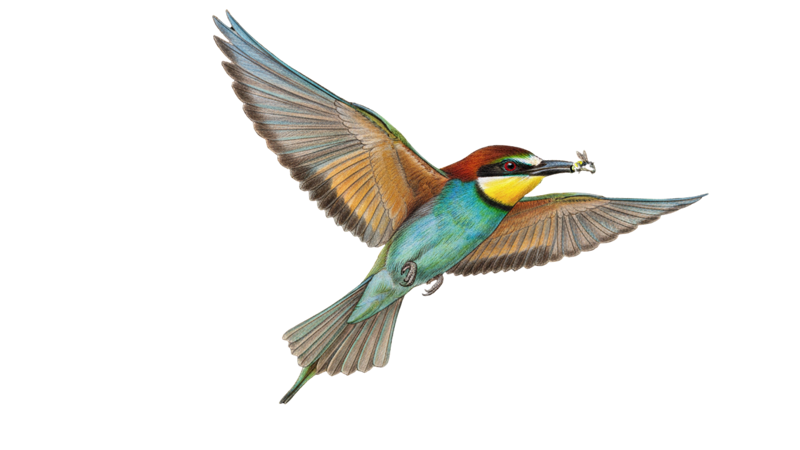
European Bee-eater
Merops apiaster
250 bees/day · burrow nesterconf 0.82
Desert Intelligence
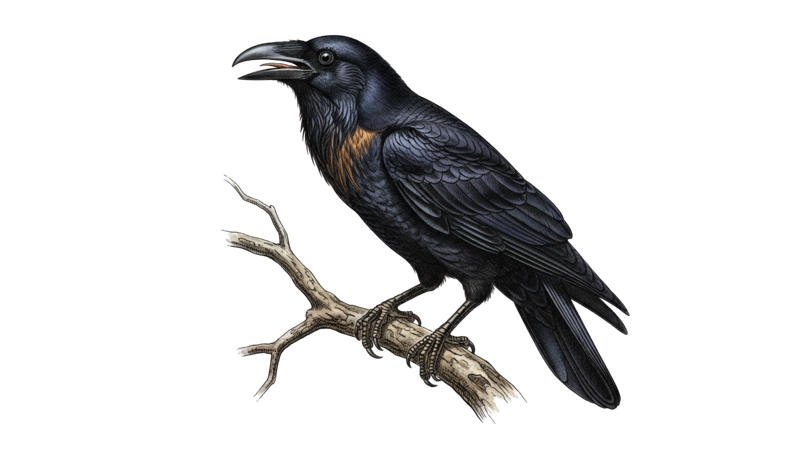
Brown-necked Raven
Corvus ruficollis
Cooperative huntingRoman ruins
Ancient Resident
Little Owl
Athene noctua
Roman ruinsAthena's companion
Desert Specialist
Desert Sparrow
Passer simplex
Resident breederSaharan endemic
The desert is not an isolated system — it is connected.
PLATE V
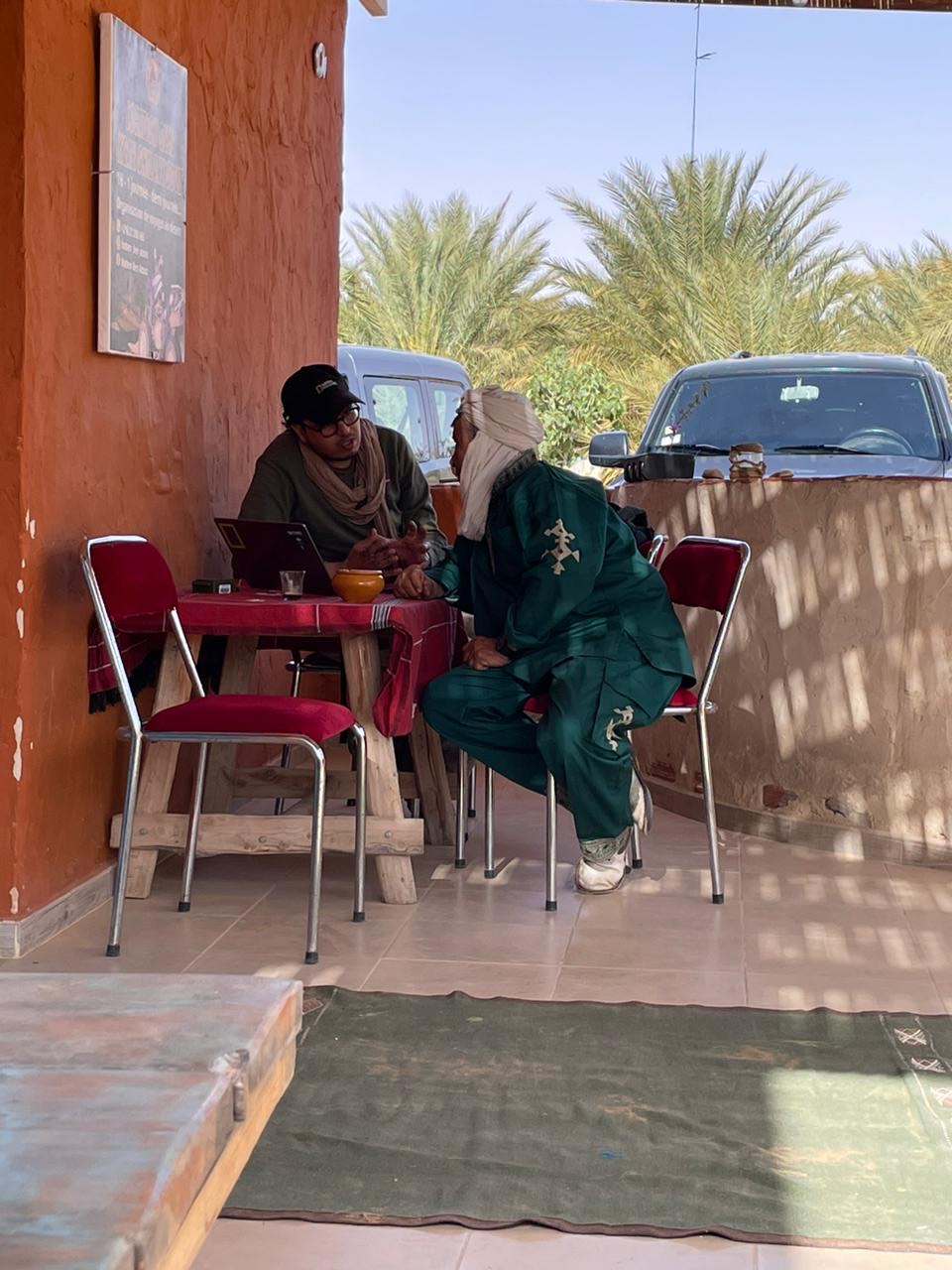
Am Ali, is a local from the region. He holds knowledge about the sand cat, gazelles and caracal and he is always insightful when we ask him about the different species he encountered.
X — What We Owe the Desert
The desert does not need to be fixed.
I drove back north through the same landscapes I had driven south through, and they looked different to me now. Not because they had changed, but because I had.
The Barbary Partridge in the Matmata Hills — six million years of unbroken desert residence. The well at Bir Soltan — ancient water drawing ancient life into a circle of improbable abundance. The hot spring at Ksar Ghilane — thirty centimetres of rising water sustaining an entire world for two thousand years of continuous human presence and uncountable millennia before that.
Aldo Leopold wrote that 'a thing is right when it tends to preserve the integrity, stability, and beauty of the biotic community.' E.O. Wilson argued that the only path to avoiding the sixth mass extinction is to protect entire ecosystems — not manage fragments, not restore approximations, but protect what remains with the seriousness that the situation requires.
The Sahara is one of the largest intact ecosystems remaining on Earth. It is not a fragment. It does not need to be managed. It needs to be recognised for what it is: a living system of extraordinary complexity, refined by evolution over millions of years.
To protect the oases that serve as lifelines for millions of migrating birds. To defend the traditional water systems that have sustained life here without exhausting the aquifers. To give back, wherever possible, the space to the animals we removed. To stop defining this landscape through the lens of what it lacks rather than through the overwhelming evidence of what it contains.
Twenty-nine species in seventeen hours. The first acoustic survey ever conducted in North Africa. The species accumulation curve still rising when the recording ended — because the dead desert, given a single night and a single microphone, could not finish speaking before the time ran out.
The desert is dead. You can hear it breathing from kilometres away.
.png)